Priya Nair
Published
What greenwashing actually is
Greenwashing is the practice of making something sound more environmentally responsible than it really is. It is not usually outright lying. More often it is a matter of vague language, selective framing, and impressive-sounding claims that fall apart the moment you ask for specifics. Learning how to spot greenwashing in recycling comes down to developing a healthy skepticism of claims that cannot be checked.
The reason greenwashing works is that most people want to make the sustainable choice and do not have time to audit every vendor. That good intention is exactly what greenwashing exploits. A company that says the right words can win business without doing the right things, as long as no one presses for evidence.
The antidote is not cynicism about sustainability itself; the antidote is specificity. Honest environmental claims are specific, measurable, and backed by records. Greenwashed claims are vague, emotional, and allergic to detail. Once you know that difference, you can see it everywhere.
The vague phrases that should raise a flag
Certain phrases are greenwashing red flags not because they are always false, but because they are so often used to sound green without committing to anything checkable. When you see these without supporting detail, treat them as an invitation to ask for specifics rather than as evidence of anything.
Watch for language like the following when it stands alone with no numbers or verification behind it:
- "Eco-friendly" or "green" with no definition of what makes it so.
- "All-natural" applied to something whose impact has nothing to do with being natural.
- "Sustainably sourced" with no standard, certification, or supplier named.
- "Environmentally responsible" with no metric attached to the responsibility.
- Nature imagery and leaf logos doing the persuading instead of facts.
What an honest claim looks like
Honest recycling claims read differently. Instead of adjectives, they offer numbers, and instead of vibes, they offer verification. A credible claim tells you what was measured, how it was measured, and where the evidence lives. It invites checking rather than dodging it.
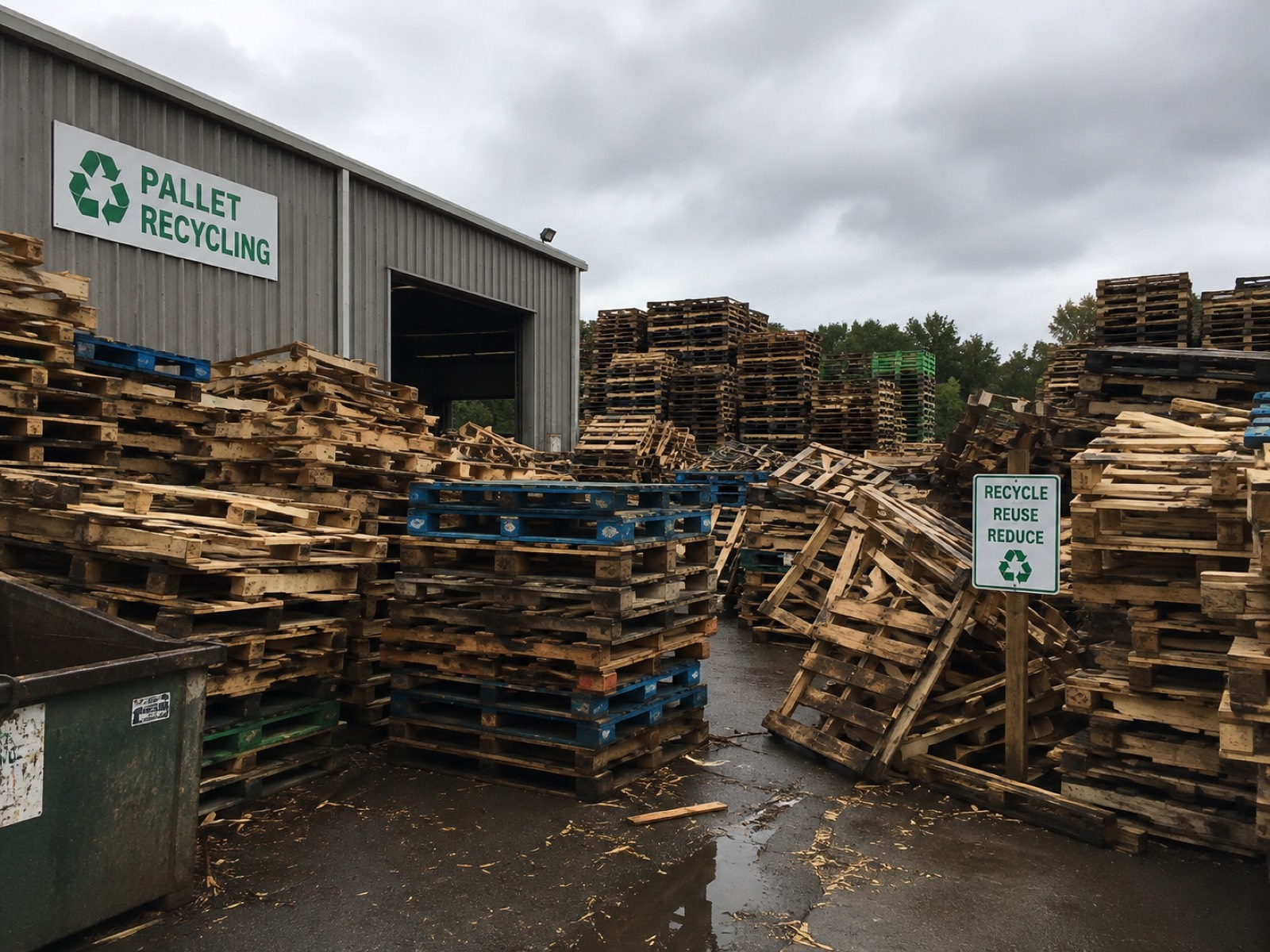
For a pallet recycler, an honest claim sounds like a diversion rate expressed as a percentage, a tonnage of wood kept out of landfill over a stated period, or a description of exactly which recovery paths pallets take and in what proportions. These are claims you can question, verify, and hold someone to. That verifiability is the whole point.
Honesty also shows up in what a company admits it cannot do. A recycler that acknowledges the limits of its process, is upfront about what happens to contaminated material, and presents its numbers as estimates where appropriate is signaling exactly the kind of rigor that greenwashing lacks. Candor about limitations is a stronger trust signal than any glossy claim of perfection.
Questions that cut through the fog
The fastest way to test a claim is to ask questions that require specific answers. Greenwashing survives on vagueness, so specific questions are its natural enemy. A genuine operator will answer readily because the answers exist; a greenwasher will deflect, generalize, or change the subject.
Useful questions include what happens to a pallet that cannot be repaired, what share of collected pallets is actually reused versus recycled versus landfilled, and what documentation the company can provide to back up its diversion figures. Each of these forces a concrete answer or exposes the absence of one.
Pay attention not just to the content of the answers but to the willingness to give them. A partner who can point to manifests, weight tickets, and clear process descriptions is operating in the open. A partner who bristles at the questions or retreats into marketing language is telling you something important without meaning to. The reaction is often as revealing as the reply.
Why specifics matter more as scrutiny rises
Sustainability claims are under more scrutiny every year, from regulators, customers, and reporting frameworks alike. That trend rewards specificity and punishes vagueness. A company that has built its reputation on unverifiable green language is increasingly exposed, because the questions are getting harder and the tolerance for hand-waving is shrinking.
For businesses choosing a recycling partner, this means the specificity that signals honesty also signals durability. A partner whose claims are backed by records will still look good when a customer or auditor digs in. A partner whose claims are all adjectives becomes a liability the moment anyone checks. Choosing verifiable partners is self-protection as much as ethics.
This is also why honest recyclers tend to welcome scrutiny rather than fear it. If your numbers are real and your records are in order, hard questions are a chance to demonstrate credibility, not a threat. The willingness to be checked is itself a competitive advantage in a market that is learning to distrust polish.
Holding your own claims to the same standard
It is worth turning the greenwashing test on your own organization too. If your sustainability report leans on vague phrases and stock nature photography, you are vulnerable to exactly the scrutiny described above. The fix is to replace adjectives with metrics: report diversion rates, tonnages, and trip counts you can actually document.
This is where a recycling partner who provides real records becomes doubly valuable. Their documentation feeds your reporting, letting you make specific, defensible claims instead of soft ones. The chain of credibility runs from the recovery yard through the manifests to the sentence in your report, and it is only as strong as its weakest, vaguest link.
Evergrain aims to make claims we can back up and to give our partners the records to do the same. If you want a recycling relationship built on numbers you can verify rather than language you have to trust, reach out by email and ask us the hard questions. Honest answers are the whole point.
Put this into practice
Ready to act on it? Request a quote, explore our services, or keep reading on the blog.