Product
Recycled Wood Pallets
The workhorse of the circular pallet economy.
The short answer
Recycled pallets are used wood pallets that have been collected, sorted, repaired, and re-graded for another cycle of service. They deliver the same load performance as new for most applications at a much lower price and a fraction of the carbon, which is why they are the default choice for cost- and sustainability-minded shippers.
Request a quote
Fill this out and we’ll reply by email with a plan and a price. It’s the same form you’ll find on every page — no phone tag required.
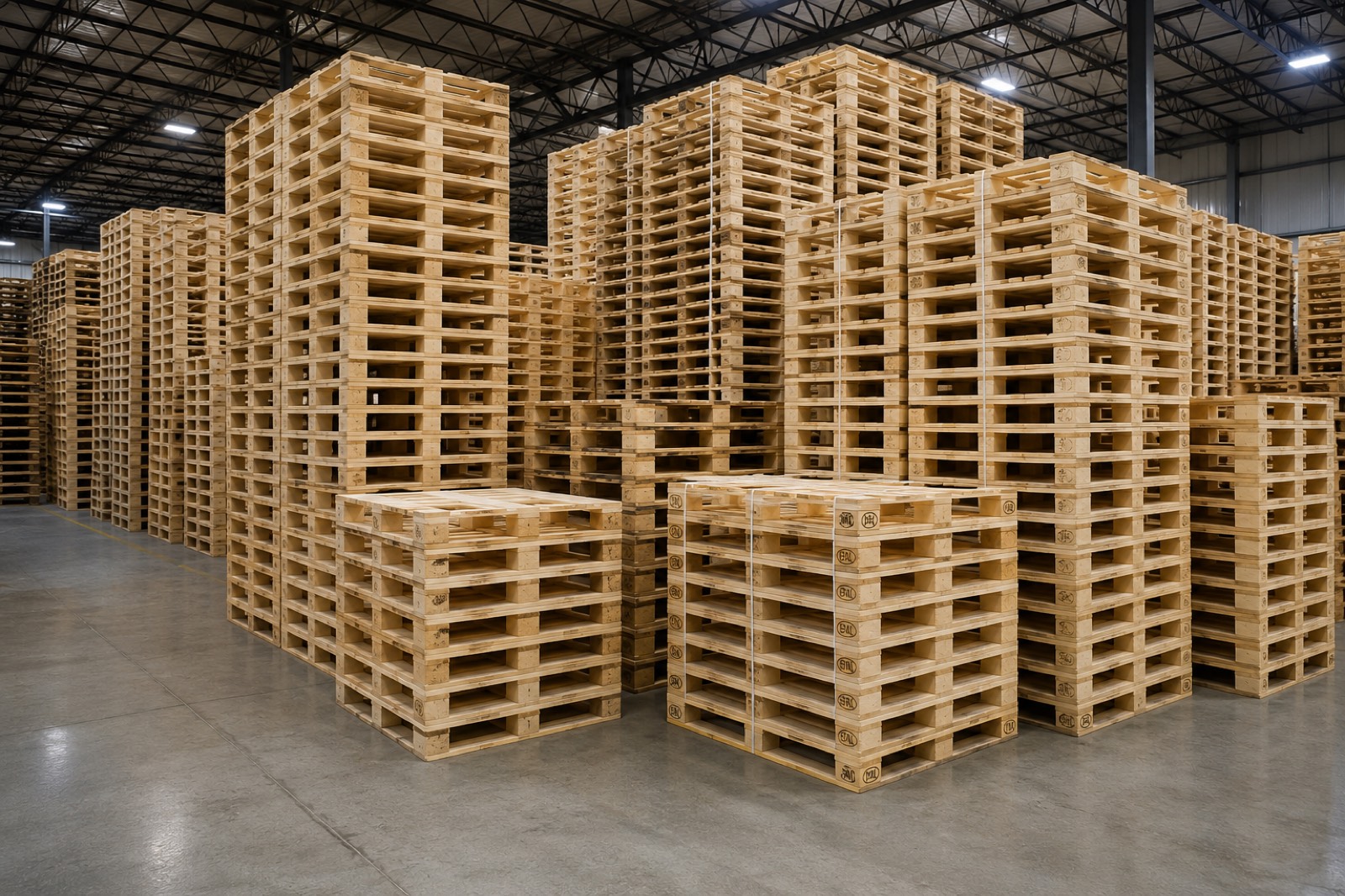
At a glance
Grade A vs Grade B — pick by application
Grade A recycled pallets are near-new: uniform, structurally strong, with clean deck boards that run smoothly on conveyors and racking. Grade B units are fully functional with visible wear — ideal where appearance and automation tolerance matter less, like one-way outbound shipments or internal transport.
Choosing the right grade avoids over-paying. If a load is going out the door and not coming back, Grade B is the economical, still-reliable choice. If it is cycling through automated equipment, Grade A earns its small premium.
- Grade A: rack- and conveyor-ready
- Grade B: sound with cosmetic wear
- Both inspected against a written standard
Greenest pallet on the market
Because the timber is already harvested and milled, a recycled pallet avoids nearly all the upstream carbon of a new one. Every cycle keeps roughly 30–50 lb of wood in use and out of landfill. Multiply across a supply chain and recycled pallets become one of the easiest large-scale emissions cuts available.
How a recycled pallet is built and repaired
A standard recycled 48x40 GMA pallet is a stringer design: three parallel stringers roughly 1.5 inches thick run the length of the unit, with seven top deck boards and five bottom boards nailed across them. The two outer stringers are notched so a forklift or pallet jack can enter from the sides as well as the ends, giving the partial four-way access most operations rely on.
When a used pallet comes into our Memphis yard, sorters pull it off the truck and check every board, stringer, and lead board for cracks, breaks, and protruding nails. Sound units go straight to grading. Repairable units move to the repair line, where broken deck boards are replaced, split stringers are reinforced with a companion board (a plug or a metal plate), and loose nails are reset or re-driven.
The result is a pallet that meets a written condition standard rather than a random used unit. That repeatability is what lets receivers, conveyors, and racking systems handle a recycled order the same way every time.
- Three-stringer, seven-board top deck typical
- Notched outer stringers for 4-way entry
- Broken boards replaced, split stringers reinforced
- Every unit inspected before it ships
Dimensions, load ratings, and what they mean
The 48x40 footprint is the North American default, sized to fit two-across in a standard 96-inch trailer or ocean container with little wasted space. A typical recycled unit weighs 30 to 50 pounds depending on the wood species and how many boards it carries. Hardwood units such as oak run heavier and stronger; softwood or mixed units run lighter.
Two numbers matter for capacity. Dynamic load is what the pallet can safely carry while being moved by a forklift or jack, usually in the 2,500 to 4,600 pound range for a sound 48x40. Static load, the weight it can hold at rest, is far higher. Rack load, the weight it can span while supported only at the ends inside a racking bay, is the most demanding figure and the one to confirm if you store loaded pallets in beam racking.
If your product is unusually heavy, dense, or concentrated on a small footprint, tell us the weight and how it will be stored so we can match you to the right grade or point you to a heavier build.
Best-fit industries and use cases
Recycled 48x40 pallets are the backbone of general distribution, third-party logistics, food and beverage warehousing, building-products supply, and retail replenishment. Anywhere goods move in unit loads and the shipment either returns to you or feeds a broad pooled system, recycled wood is almost always the economical answer.
They are especially strong for high-volume shippers who buy pallets by the truckload and cannot justify new-wood prices for routine freight. Specialty sizes such as 48x48, 42x42, and 36x36 are also available in recycled stock for drum, chemical, and beverage applications.
- 3PL and general distribution
- Food, beverage, and grocery
- Building products and hardware
- Retail replenishment and pooled systems
How to order and what to spec
Ordering is straightforward once we know four things: the size you need, the grade (A or B), your typical load weight, and how the pallet is stored and handled. With those, we can quote current availability and pricing and tell you whether recycled stock covers your requirement or whether a remanufactured or new build fits better.
Recycled pallet supply moves with the local recovery market, so lead times and pricing shift week to week. For steady demand we can set up a standing order and buyback program so your empties come back to us for recovery instead of piling up. Email us your specs and volume and we will scope a program around your operation.
FAQ
Frequently asked questions
Are recycled pallets as strong as new?
For the vast majority of loads, yes. A graded Grade A recycled 48x40 carries typical distribution loads comfortably. For extreme weights or tight export specs we will recommend new or engineered units.
Will the load be consistent?
Yes — that is the point of grading. A Grade A order arrives uniform in size and condition, not as a mixed pile.
What sizes besides 48x40 do you carry?
The 48x40 GMA is by far the most common, but recycled stock is also available in sizes like 48x48, 42x42, 40x48, and 36x36. Availability varies with the recovery market, so ask us about your specific footprint.
How long does a recycled pallet last?
A sound unit can be reused many times and repaired repeatedly. With normal handling a recycled 48x40 typically serves for several trips before it needs another repair cycle, and boards recovered from retired pallets are rebuilt into remanufactured units, so almost nothing is wasted.
Do you buy back used pallets?
Yes. We buy and collect used pallets across the Memphis region and beyond. Setting up a buyback loop keeps your empties out of the dumpster, feeds our recovery stream, and can offset your pallet spend.
Can recycled pallets be heat-treated for export?
They can be, but for export it is often cleaner to spec a unit built and stamped to ISPM-15. Tell us the destination and we will recommend the compliant, cost-effective route.
How should I store recycled pallets?
Keep them off bare ground and out of standing water, ideally under cover or tarped. Wood absorbs moisture, and dry pallets are lighter, stronger, and far less likely to grow mold before use.
Ready to give your pallets another life?
Buy, sell, recycle, or haul — start with a fast, no-obligation quote and we’ll take it from there.