Product
Block & Euro Pallets
True four-way entry for automated, global supply chains.
The short answer
Block pallets use blocks instead of stringers to allow genuine four-way forklift and pallet-jack entry, which makes them the standard for automated warehouses and international trade. Euro (EUR/EPAL) pallets are the 1200x800 mm block standard used across Europe. Evergrain supplies both in recycled and new builds.
Request a quote
Fill this out and we’ll reply by email with a plan and a price. It’s the same form you’ll find on every page — no phone tag required.
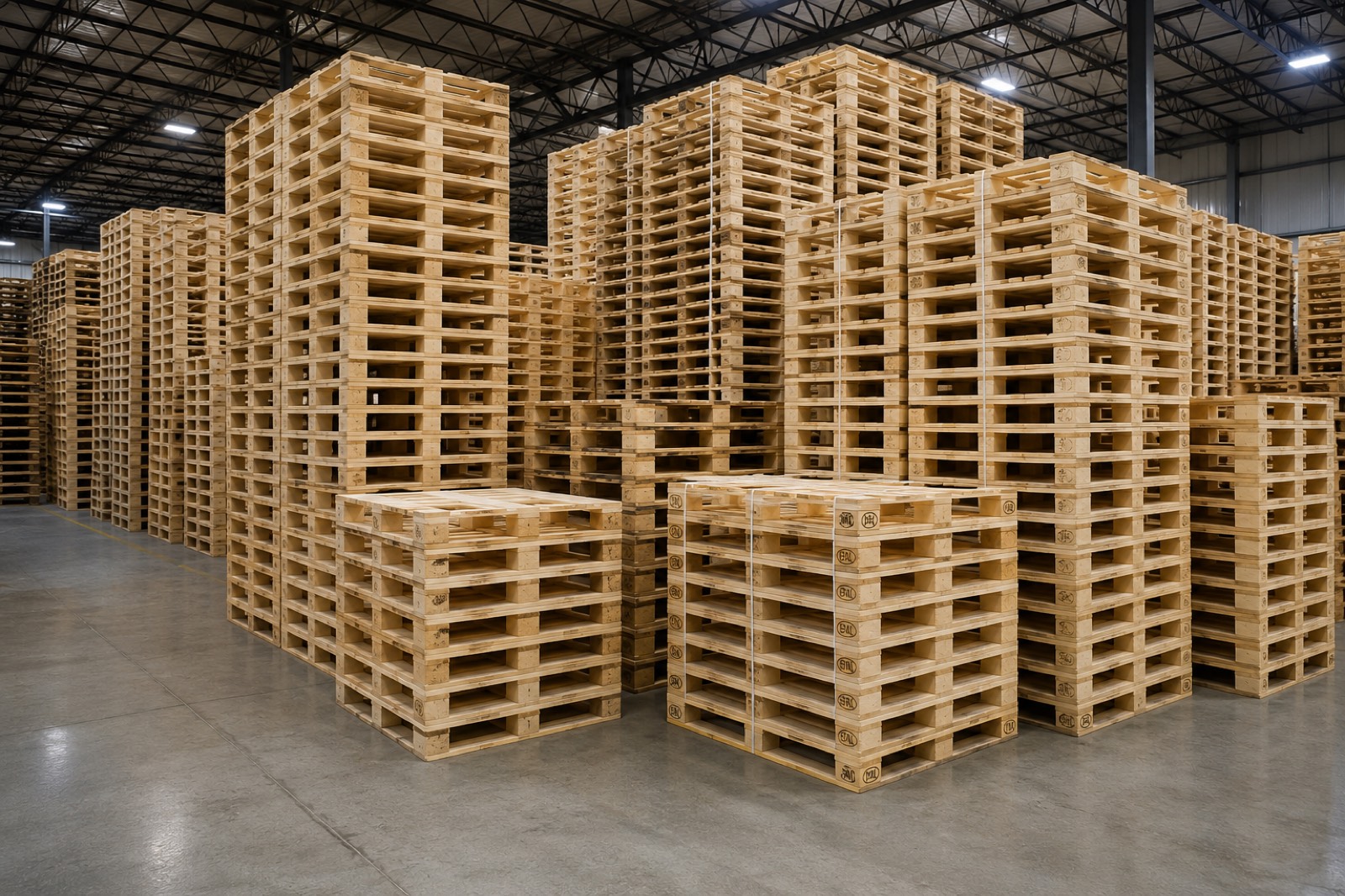
At a glance
Why block construction matters
Stringer pallets only allow full four-way entry when notched, and even then the jack access is limited. Block pallets sit on nine blocks with openings on all four sides, so forklifts and pallet jacks enter cleanly from any direction — essential for automated storage and retrieval systems and dense cross-docking.
- Nine-block base
- Full four-way jack and fork access
- Strong under automation
- CHEP/PECO-style footprints
Euro pallets for global lanes
If you ship into Europe, the 1200x800 mm EUR/EPAL pallet is often expected by receivers and fits standard European racking and truck dimensions. We supply Euro-format pallets and can heat-treat to ISPM-15 for compliant international movement.
The nine-block base explained
A block pallet is built on nine solid blocks: one at each corner, one at the midpoint of each side, and one in the center. Top deck boards sit above the blocks, and typically three bottom runners tie the blocks together underneath. Because the openings between blocks are clear on all four sides, a forklift or pallet jack gets full-width entry from any direction.
That geometry is what separates a true four-way block pallet from a notched stringer pallet. A notched stringer allows a fork in from the sides, but the notch is shallow and a pallet jack cannot get its wheels fully underneath from the ends. Automated equipment, which cannot improvise the way a human operator does, needs the clean, consistent openings a block base provides.
- Nine blocks: corners, sides, and center
- Three bottom runners tie the base together
- Full-width openings on all four sides
- True jack access, not just fork access
Dimensions and load ratings
The EUR/EPAL pallet measures 1200 by 800 millimeters, weighs roughly 20 to 25 kilograms, and is generally rated for a working (dynamic) load around 1,000 kilograms, with much higher static capacity when floor-stacked. North American block pallets in the 48x40 footprint carry comparable distribution loads to their stringer counterparts, with the block base adding rigidity that helps in racking.
The tradeoff is weight and cost: nine blocks plus runners use more lumber than three stringers, so a block pallet is heavier and pricier than an equivalent stringer unit. You are paying for the four-way access and the rigidity, which is why block construction is worth it for automation and export but not for simple manual handling.
Block versus stringer: which to choose
Choose stringer pallets for straightforward, manual, cost-driven handling where a human operator positions the forks. They are lighter, cheaper, and perfectly adequate for the majority of domestic freight. Choose block pallets when automation, dense cross-docking, or international receiving is in play and the extra cost buys reliability.
A practical rule: if a jam, a mis-pick, or a rejected international shipment costs you far more than the price difference between the two designs, spec block. If not, a standard 48x40 GMA stringer pallet is the economical call. We are happy to talk through your specific lanes and equipment before you commit.
- Stringer: lighter, cheaper, manual handling
- Block: automation, cross-dock, and export
- Block adds rigidity for racking
- Match the spend to the cost of a failure
Recycled block stock and sustainability
Block and Euro pallets are durable by design and hold up to many cycles, which makes them strong candidates for pooled and closed-loop programs where the same units circulate for years. We supply recycled block and EUR/EPAL stock alongside new builds, so you can often get four-way, automation-ready pallets without paying full new-wood prices or carbon.
When a block pallet finally wears out, its blocks and boards come back into our recovery stream to be rebuilt or ground for reuse. Buying recycled block stock where availability allows, and returning empties through a buyback loop, keeps the sustainability profile of these heavier pallets much closer to that of recycled wood.
FAQ
Frequently asked questions
Do I need block pallets?
If you run automated handling, dense cross-docking, or ship internationally, block or Euro pallets are usually worth it. For simple stringer handling, a standard 48x40 GMA is more economical.
Can you supply recycled block pallets?
Yes — we carry recycled block stock as well as new builds, depending on availability and your spec.
What is the load rating of a Euro pallet?
An EUR/EPAL 1200x800 mm pallet is generally rated for a working load of around 1,000 kilograms (about 2,200 pounds), with much higher static capacity when floor-stacked. Confirm your exact load with us and we will match the right unit.
Why are block pallets more expensive than stringer pallets?
They use more lumber. Nine blocks plus bottom runners is more material than three stringers, so a block pallet is heavier and costs more. You are paying for true four-way access and added rigidity, which is worth it for automation and export.
Are your Euro pallets EPAL certified?
We supply Euro-format 1200x800 mm pallets built to the standard footprint and can heat-treat them to ISPM-15 for compliant export. If your receiver requires a specific licensed EPAL stamp, tell us up front so we source accordingly.
Can I heat-treat block and Euro pallets for export?
Yes. We provide ISPM-15 heat-treated and stamped block and Euro pallets, with the wood core held at 56C for 30 minutes so your international freight clears customs.
Do block pallets work in beam racking?
Yes, and the rigid nine-block base often performs well there. For racking always confirm the rack-load figure with us, since spanning a bay unsupported in the middle is the toughest demand on any pallet.
Ready to give your pallets another life?
Buy, sell, recycle, or haul — start with a fast, no-obligation quote and we’ll take it from there.