Priya Nair
Published
The pallet that can't be saved
Every pallet eventually reaches a point where repair no longer makes sense. The stringers are cracked beyond salvage, too many boards have failed, or the unit has simply been rebuilt as many times as it can bear. This is not a failure of the circular economy; it is the natural end of a long working life. The question is not whether a pallet dies, but what happens to the wood when it does.
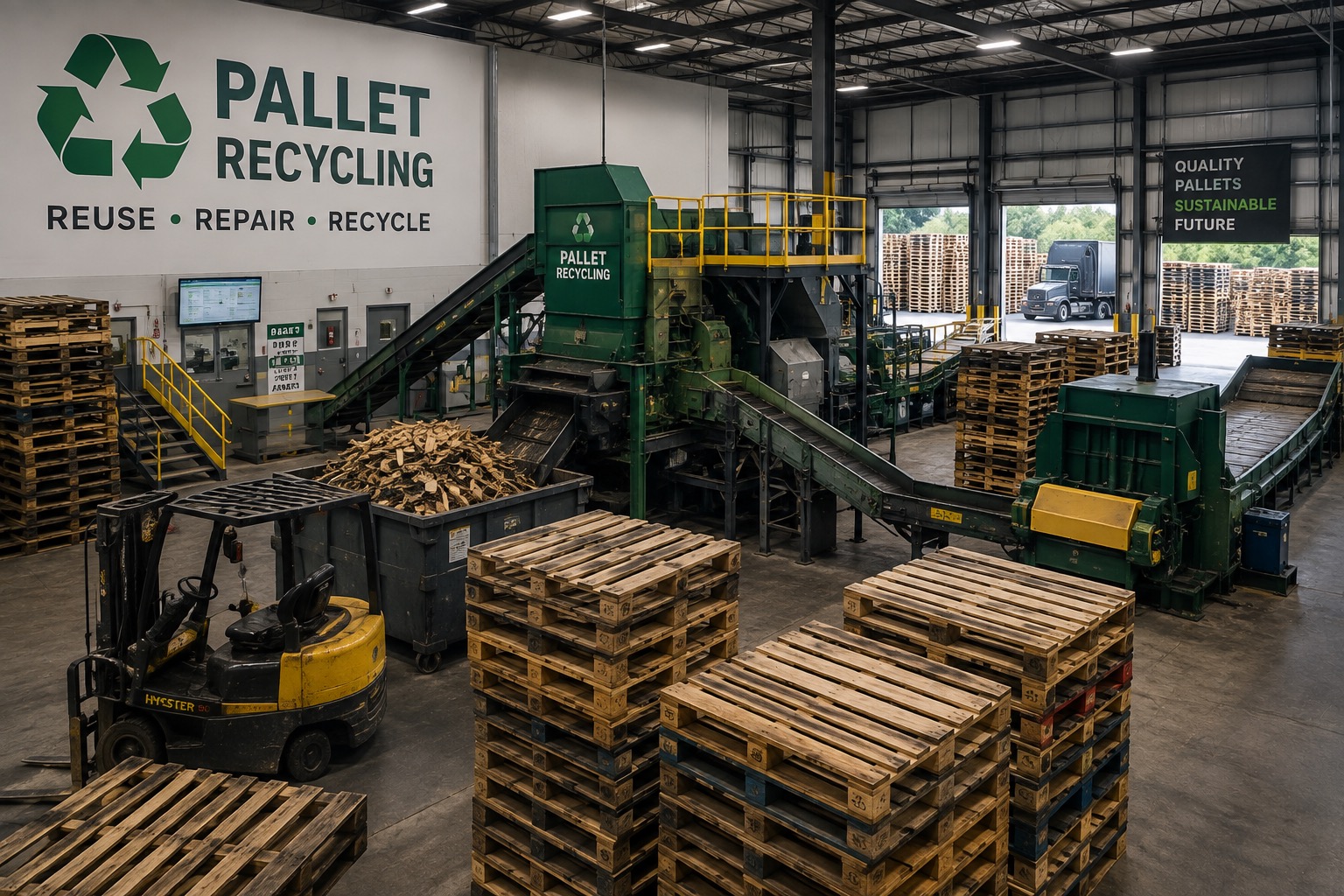
This is where pallet wood recycling into mulch and other material streams comes in. A dead pallet is still a bundle of dry, sorted, relatively clean wood. That makes it a useful feedstock for several downstream products, provided it is handled properly. The wood does not have to become waste; it can become the raw material for something else.
Getting this stage right matters because it is the last chance to keep the carbon in that wood doing useful work instead of rotting in a landfill and releasing methane. End-of-life is not an afterthought in a good pallet program. It is a designed step, planned in advance rather than improvised at the dumpster.
The main second-life paths
Clean, untreated pallet wood can be routed to several destinations once it is ground down. Each has different requirements and different value, so a good recycler matches the material to the highest use it qualifies for.
The common second-life products for ground pallet wood include:
- Landscape mulch: ground wood, sometimes dyed, used for gardens, playgrounds, and grounds keeping.
- Animal bedding: clean, untreated wood shavings used in stables and barns.
- Fiber and particle stock: wood chips used as feedstock for engineered wood products.
- Biomass fuel: wood burned to generate heat or electricity, avoiding landfill methane.
- Colorized or blended soil products: mulch mixed into landscaping and erosion-control blends.
Why mulch is often the sweet spot
Among the end-of-life options, mulch frequently offers the best combination of value and simplicity for clean pallet wood. It keeps the carbon in a stable form for a good while longer, since mulch on a garden bed breaks down slowly and even feeds soil as it does. It also displaces demand for other landscaping material, and it turns a disposal cost into a saleable product.
Mulch is not automatically the greenest choice in every case, and it depends on local demand and transport distances. But for many recyclers it hits a practical sweet spot: the processing is straightforward, the market is steady, and the outcome keeps wood carbon working rather than venting. That combination is why so much recovered pallet wood ends up as mulch.
The critical caveat is contamination. Pallets that have carried certain chemicals, been treated with the wrong preservatives, or been painted are not suitable for mulch that touches gardens or play areas. Clean, untreated stock is what makes high-value mulch possible, which is one more reason to keep pallet streams sorted from the start.
Biomass: better than burial, not better than reuse
Biomass energy sits lower on the value ladder than mulch or fiber, because burning the wood releases its carbon immediately, even if it does so more usefully than a landfill would. The honest way to describe biomass is as a floor, not a ceiling. It is far better than letting wood rot anaerobically and vent methane, but it is not as good as keeping the material intact for reuse or long-lived products.
That said, biomass has a legitimate role for wood that cannot qualify for anything higher. Contaminated or heavily degraded pallet wood that is unfit for mulch or bedding can still displace fossil fuel in a properly permitted energy facility. In that narrow case, biomass is the responsible endpoint rather than a compromise.
The mistake is to reach for biomass first because it is convenient. Burning wood that could have been reused, repaired, or turned into mulch destroys value and releases carbon prematurely. Biomass belongs at the end of the decision tree, after the higher-value options have genuinely been ruled out.
How sorting decides everything downstream
The single biggest factor in how much value a dead pallet yields is how well it was sorted before grinding. Clean, untreated, uncontaminated wood can go to high-value uses like garden mulch and animal bedding. Mixed or contaminated wood gets downgraded to lower-value uses or, worst case, disqualified from recycling entirely.
This is why upstream discipline pays off at the very end of the chain. A facility that keeps clean pallets separate from painted, chemically treated, or debris-laden wood preserves options that a facility with a single mixed pile has already thrown away. Sorting is cheap; the value it protects is not.
A good recovery partner handles this sorting as a matter of course, inspecting incoming material and routing it to its best use. If you are unsure whether your end-of-life pallets are reaching their highest-value second life, the Evergrain team can walk through your stream by email and identify where value is leaking.
Closing the loop on the wood itself
End-of-life processing is what makes the pallet loop truly circular rather than merely long. Reuse and repair extend a pallet's life, but at some point the wood must go somewhere. Turning it into mulch, bedding, fiber, or fuel ensures the loop closes cleanly instead of dead-ending in a landfill.
It also reframes what disposal even means. In a circular pallet program, there is very little true disposal. There is reuse, then repair, then material recovery, then energy recovery, and only the smallest sliver of genuinely unusable material at the very end. Each step keeps carbon in play a little longer.
For anyone building a sustainability program, end-of-life wood is a quiet source of easy wins. It transforms a waste line into a recovery line, cuts hauling costs, and improves diversion metrics all at once. The pallet that could not be saved can still do a great deal of good on its way out.
Put this into practice
Ready to act on it? Request a quote, explore our services, or keep reading on the blog.