Service
Closed-Loop Pallet Retrieval Program
Your pallets, tracked home again.
The short answer
A retrieval program recovers the pallets that leave your dock on outbound shipments and vanish into customers’ and distributors’ yards. Evergrain locates, collects, and recirculates those assets so you buy fewer replacements — a true closed loop that turns a leaking one-way expense into a managed, circular system.
Request a quote
Fill this out and we’ll reply by email with a plan and a price. It’s the same form you’ll find on every page — no phone tag required.
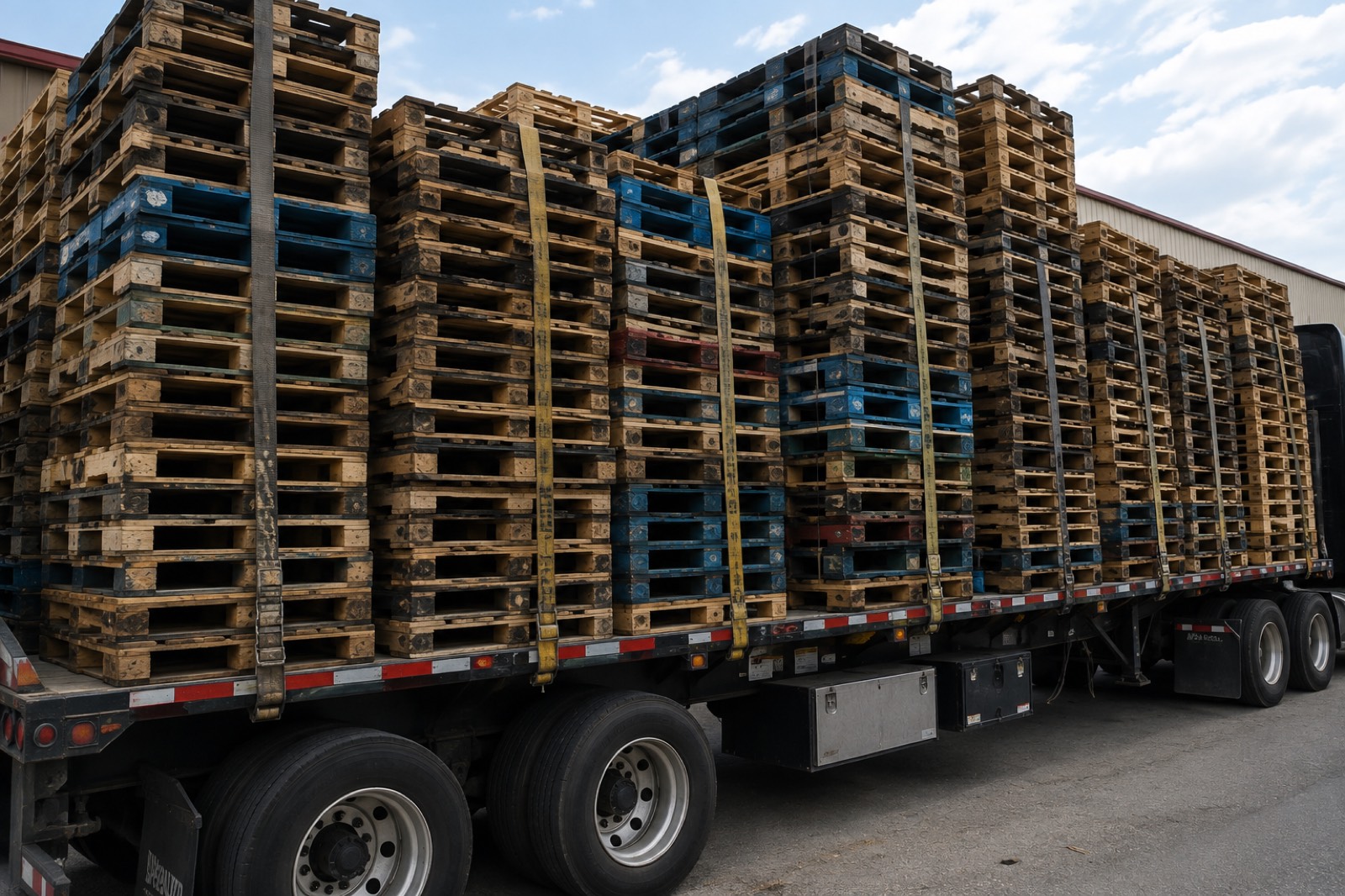
Stop the one-way leak
Every pallet that ships out and never comes back is money walking out the door. Multiply that by a year of outbound volume and the replacement spend is enormous. Retrieval plugs the leak by systematically recovering those units from wherever they land.
How the loop closes
We map where your pallets go, set up recovery points at your high-volume receivers, and route pickups so units flow back to you or into the shared pool. Counts are reconciled so you always know how many assets are in circulation and how many have come home.
- Downstream recovery points
- Reconciled asset counts
- Recirculation into your inbound supply
- Lower net replacement rate
The circular-economy showpiece
A retrieval program is the purest expression of circularity in the pallet world: the same physical asset cycles for years instead of being consumed once. It is the strongest sustainability story you can tell, and it lowers cost while telling it.
How we set a program up
A retrieval program is built, not switched on. We start by mapping where your pallets actually go — which receivers see the most volume, how often, and how far away they sit. That map tells us where recovery points earn their keep and where the leak is worst, so effort goes where the return is highest.
From there we establish collection at your high-volume destinations and fold pickups into existing freight routes wherever possible, so recovery happens without new overhead landing on your team. Counts are reconciled on a regular cycle so you can see how many assets are in circulation, how many have come home, and how the net replacement rate is trending. The system runs quietly in the background once it is dialed in.
- Map outbound destinations and pallet flow
- Establish recovery points at high-volume receivers
- Fold pickups into existing routes to avoid overhead
- Reconcile counts and track net replacement rate
What the economics look like
The value of retrieval scales with how much you spend replacing lost pallets. If you ship a large, steady volume to a repeating set of destinations, the units you recover directly offset units you would otherwise have to buy — and that offset compounds every cycle the asset stays in your loop instead of walking away for good.
Pricing reflects the recovery logistics: how concentrated your destinations are, how easily pickups pair with existing routes, and the volume in play. Concentrated, high-volume flows are the sweet spot because recovery is cheap per unit and the replacement savings are large. We will model your specific pattern and tell you plainly whether the math favors retrieval or a simpler buy-and-sell loop.
When retrieval is not the right answer
We would rather lose the sale than set up a program that does not pay. Retrieval struggles when your outbound is scattered across many one-off destinations, because chasing single pallets across the country costs more than the pallets are worth. In those cases a buy/sell loop or a straightforward recycling relationship usually serves you better.
The honest test is concentration and repeatability. If the same handful of receivers absorb most of your outbound volume week after week, retrieval tends to win. If every shipment lands somewhere new, it usually does not. Tell us your real pattern and we will point you to the model that actually lowers your total cost, even if that model is not this one.
The strongest sustainability story you can tell
Of everything in the pallet world, a closed retrieval loop is the cleanest circular-economy narrative. The same physical asset cycles for years, so you are not just recycling wood — you are avoiding the need to produce replacement pallets at all. That is a step up the waste hierarchy from recovery to genuine reuse, and it shows.
For companies with public sustainability commitments, retrieval gives you something concrete: a documented count of assets kept in circulation and replacement purchases avoided. It is a story that holds up to scrutiny precisely because it also lowers your cost — the incentive and the environmental benefit point the same direction, which is what makes it durable.
FAQ
Frequently asked questions
Does retrieval make sense for my volume?
It shines when you ship a lot of pallets to a repeating set of destinations. If your outbound is scattered and one-off, a buy/sell loop may fit better — tell us your pattern and we will advise honestly.
How do you find pallets that already left?
We work with your receiving partners to establish recovery points and fold pickups into existing routes, so recovery happens without new overhead on your side.
Can this feed a shared pool?
Yes. Recovered assets can return directly to you or flow into a managed shared pool depending on which model lowers your total cost.
How do you track which pallets are mine?
We reconcile counts on a regular cycle so you always know how many assets are in circulation and how many have returned. For programs that need it, units can be marked or otherwise identified to distinguish your assets at recovery points.
What if my receivers will not cooperate?
Recovery works best when it fits naturally into your partners existing dock routine, which is exactly what we design for. We fold pickups into routes and set up simple collection points so there is little to no burden on the receiver, which is usually enough to earn cooperation.
How is this different from just buying and selling used pallets?
Buy/sell treats each pallet as consumed once and replaced. Retrieval keeps the same physical asset cycling back to you, so you buy fewer replacements over time. It is a true closed loop rather than a one-way flow, which is why it is the stronger option for high, repeating volumes.
Can retrieval combine with your transport and recycling services?
Yes, and it usually should. Recovery pickups ride on the same routing as deliveries and empty hauls, and any recovered units too worn to reuse flow straight into recycling. One coordinated plan covers the whole lifecycle.
How soon will I see savings?
It builds as the loop fills. The first cycles establish recovery points and reconcile counts; savings show up as recovered units start offsetting replacement buys and compound with each subsequent cycle. We track the net replacement rate so the trend is visible, not just assumed.
Ready to give your pallets another life?
Buy, sell, recycle, or haul — start with a fast, no-obligation quote and we’ll take it from there.